


Press Releases
Browse press releases below or select media contacts to reach out to our team
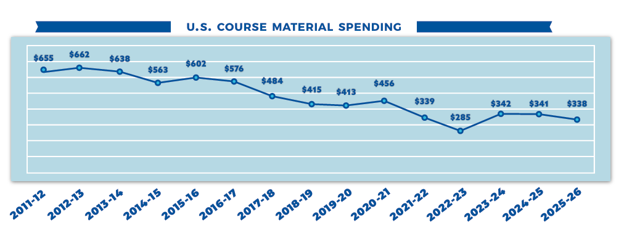
Contact: publicrelations@nacs.org FOR IMMEDIATE RELEASE OBERLIN, OHIO (July 20, 2026)— College students reported spending slightly below last year on their course materials during the 2025-26 academic year, according to the Student Watch™: Attitudes and Behaviors toward Course Materials: 2026 Report, the National Association of College Stores’ (NACS) annual survey of college students. Total course material spending for required materials totaled $338 per student for the year. Student spending this year is lower than at any point between 2007 and 2021 and about 50% of spending in 2007-08 when students paid $701 on average for course materials.
Contact: publicrelations@nacs.org FOR IMMEDIATE RELEASE OBERLIN, OHIO (February 23, 2026)— Print is no longer the most widely used course material format by faculty. According to the Faculty Watch™: 2025 Report, the National Association of College Stores’ (NACS) annual survey of college teaching faculty, just 63% of faculty said they used a print material in one or more of their courses in the past year. Meanwhile, e-book use increased to 71%. In 2024, 70% of faculty used print materials in one or more of their classes, and 70% were using e-books. Regardless of use, more faculty still prefer print to digital. Faculty format preferences have changed very little in the past few years. College faculty, on average, required fewer course materials during the 2025-26 academic year.. Faculty only required 3.4 materials on average across the 3.7 courses they taught. This was the lowest number of materials required by faculty since Faculty Watch began tracking this measure in 2016. In 2024, faculty required 3.5 materials across 3.8 courses. In 2020, faculty required 6.0 materials on average across the same number of courses. More faculty this year report using open educational resources (OER). This year, 47% of faculty reported using OER. This is an increase from 44% last year and 39% in 2023. Faculty awareness of OER also increased this year. Faculty continue to report that certain challenges or barriers may keep them from using OER more often in their courses. More than a third of faculty (35%) had concerns about the quality of OER materials. Almost as many were not sure what titles or resources were available. About 20% of faculty said concern about the availability of instructor resources like slide decks or test banks was a barrier to adopting OER. Faculty have been slow to adopt and use AI. Yet more than half of faculty (54%) say they are using AI in their academic work. The most common use case is content creation (35%) followed by administrative tasks (30%). Only about half of faculty say they are open or very open to using AI tools in the academic work in the future. When asked to tell us what training or support they would find most helpful as they navigate AI in higher education, the top faculty answers were ethical guidelines, tool recommendations, and training workshops. Faculty raised concerns about possible misuse of AI by students in the classroom. Just 8% of faculty strongly agreed that they could spot when a student had used AI to complete or write an assignment. About a third (34%) agreed. Almost half of faculty (48%) strongly agreed that they worried about AI being used for plagiarism or cheating. Faculty interest in affordable access programs remains high. Affordable access programs, whether offered on a course-by-course basis when offered for all courses campus-wide, ensure students have access to all their required course materials on or before the first day of class at below retail prices with the choice to opt out of the programs. When surveying faculty who had not previously participated in an affordable access program, more than 56% of respondents expressed interest in a course-by-course access program and 57% of respondents indicated interest in programs that cover all courses. Most faculty (52% or more) participating in a course-by-course access program agreed that having the course materials provided through the program made it easier to plan, increased affordability, and made the first day of teaching more productive. About a third (32%) noticed improvements in student engagement. Other key findings from the report, which compiled responses from approximately 963 college faculty from 22 two- and four-year colleges and universities in the U.S. and Canada, include: This year 58% of faculty knew the retail cost of all the materials assigned in their courses and 24% knew the retail cost of at least some of their materials. More than half of faculty (62%) said they would be unlikely to continue with an adoption if the course materials cost more than what they felt was reasonable for a student to pay. The top three areas where faculty wanted assistance from the college store were help with understanding affordability of course materials and if more affordable options exist (33% of faculty), help learning about alternative course material models (29% of faculty), and identifying and addressing accessibility concerns in course materials (also 29%). Almost all faculty told us that students are first required to use their book in either the first (73%) or second (20%) week of class. Students were typically required to read or use their book weekly or more often during the fall 2025 term. Faculty Watch™ is developed by OnCampus Research™, the research arm of the National Association of College Stores. Reporters interested in obtaining a copy of the report should email publicrelations@nacs.org . About The National Association of College Stores: About The National Association of College Stores: The National Association of College Stores (NACS) is the professional trade association representing the collegiate retailing community. Our members are primarily campus stores owned by colleges, universities, and other nonprofit K-20 institutions across the United States. We conduct extensive research into course material use and affordability, partner with student organizations and other stakeholders to advance course material affordability efforts, establish best practices, and promote industry standards.