


NACS Student Watch Report: Course Materials Spending at Historic Lows, Students Want More Support for AI, High Satisfaction for Access Programs
Contact: publicrelations@nacs.org
FOR IMMEDIATE RELEASE
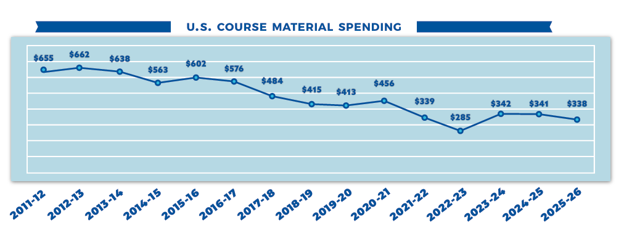
OBERLIN, OHIO (July 20, 2026)— College students reported spending slightly below last year on their course materials during the 2025-26 academic year, according to the Student Watch™: Attitudes and Behaviors toward Course Materials: 2026 Report, the National Association of College Stores’ (NACS) annual survey of college students. Total course material spending for required materials totaled $338 per student for the year. Student spending this year is lower than at any point between 2007 and 2021 and about 50% of spending in 2007-08 when students paid $701 on average for course materials.
More than half of students (54%) say they are satisfied with course-by-course course material access programs, which provide students first day access at below retail costs (15% extremely satisfied and 39% somewhat satisfied), while only14% say they are dissatisfied (4% extremely dissatisfied and 10% somewhat dissatisfied). Sixty-four percent of participants said the access program was somewhat or much better than other methods of obtaining course materials while 23% said it was about the same. Among non-participants, 66% believed course-by-course access programs would be a better option than other ways of obtaining course materials. Top reasons for satisfaction with access programs were convenience and having materials on the first day of class.
Similar to last year, 72% of students said they had been assigned at least one free or non-paid-for material during the academic year. The number of students reporting being assigned free or non-paid materials has slowly been increasing over the years but has remained steady for the past few years. Non-paid materials included instructor handouts, website articles, class notes, professional journals and articles, web searches, social media, general consumer books (novels, for instance), and free textbooks. (While students did not pay for them directly, some of these sources are paid for by student tuition and fees, such as instructor-developed materials, journal articles, and digital book licenses at the campus library.)
This year, 32% of students preferred print and 37% preferred digital, making digital the top format choice for students for the third year in a row. Preference for print materials has been declining over time. Meanwhile, preference for digital materials has increased steadily since 2016, even in years when preference for print remained steady. Older students and first-generation students had stronger preference for print. The top reasons students prefer digital were that they don’t have to carry a physical book around, access on multiple devices, ability to copy/paste or print, easier to read/navigate than print, and immediate access after purchase.
More students this year reported using AI tools on a regular basis. About a quarter (26%) said they never use these tools and 16% said they only use them once or twice a term. Yet, around a third of students said they use AI tools once a week or more, an increase from last year. About 65% of students agreed that students should be involved in university AI decisions. More than two-thirds of students (68%) felt that universities should provide training for students on effective use of AI tools. And more than 80% said that an over-reliance on AI could hurt their academic performance.
Around one in four students decided not to acquire at least one course material. However, students who skipped acquiring materials only spent $20 less on average per year than students who obtained all materials.
Student Watch™ is developed by OnCampus Research™, the research arm of the National Association of College Stores. Other key findings from the report, which compiled responses from approximately 11,177 college students from 34 two- and four-year colleges and universities in the U.S., Canada, and Jamaica, include:
- Tech spending increased sharply this year to $546, with more students purchasing a new computer/laptop.
- Most students who purchase materials purchase at least some of them from their campus store (62% of students who purchase). More students reported purchasing from the campus store online than in-person.
- In spring 2026, about 24% of students reported downloading a course material, unpaid, without proper authorization, violating copyright law.
- About a quarter of students say they may not have sufficient resources to cover college expenses including housing, food, transportation, and course materials.
Members of the media interested in a copy of the report should email publicrelations@nacs.org.
About The National Association of College Stores: The National Association of College Stores (NACS) is the professional trade association representing the collegiate retailing industry. NACS represents campus retailers and industry-related companies that supply course materials and other merchandise and services to campus stores. NACS provides education and other resources that help its member stores support student success, the campus experience, and the missions of higher education institutions.
About The NACS Foundation: In operation for almost four decades, the NACS Foundation is the only philanthropic resource for the campus store industry. Since its inception, it has disbursed more than $3 million for industry education and research and awarded more than 3,000 professional development grants to college store professionals.