


NIL Doesn't Need to be a Strange, New World
by Dan Angelo
There are some things the campus store should know about name, image, and likeness.
For instance, paying for the name or likeness of athletes to promote a product started in the 1920s. And despite the hype, reports of million-dollar deals for college athletes are just not the norm. One other thing, NIL is not going away.
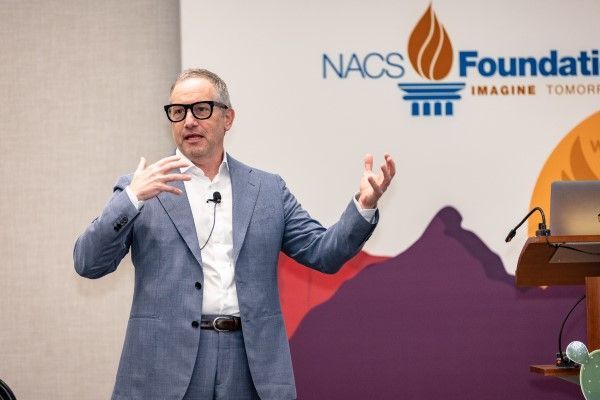
“There are a lot of different kinds of NIL activities,” said Bill Carter, founder of Student-Athlete Insights, during his “Decoding NIL: What It Means for Campus Retail” education session at CAMEX26 in Phoenix, AZ. “Essentially, NIL tends to be a social-media endeavor. About 80% of all NIL activity is social media in nature. Yes, they do appearances and sell their own merchandise and do camps and clinics and private instruction, but for most student-athletes, this is about social media.”
Student-Athlete Insights is an industry leader in NIL education, consulting, and research, helping athletes, brands, and universities work through NIL opportunities. Carter was also the co-founder of the sports agency Fuse and now works with more than 30 Division I universities and their students on NIL issues. In addition, he teaches courses on the subject at Boston College, Boston, MA, and the University of Vermont, Burlington.
“The next time you’re reading an NIL article or listening to something, try to consider NIL from an entire ecosystem perspective,” he said. “In other words, 99% of the news media really focuses on student-athletes and compensation, but there’s much more to the ecosystem. There’s a lot more going on behind the scenes in terms of what student-athletes are doing.”
Carter explained that NIL comes in three distinct forms.
Free market NIL is the relationship between a brand or business and the student-athlete promoting that product or business. Collective NIL is relatively new and includes boosters who band together to support the institution and its athletes. The third form is university NIL, which is essentially a form of revenue sharing.
The revenue sharing portion became necessary when the courts ruled (in June 2025) that universities in the Power 4 conferences (Atlantic Coast Conference, Big Ten, Big 12, and Southeastern Conference) are required to share $20.5 million annually with their athletes at each institution. How the schools dole out that money is up to the university.
Mid-major schools in Division I are not required to participate and can choose the amount they want to share with their student-athletes if they do. Carter reports that each mid-major institution in the revenue-sharing program will distribute roughly $300,000 to their student-athletes this year.
“About 80% to 85% is going to football, some percentage is going to men’s basketball, and some percentage is going to women’s basketball,” Carter said. “Then, either nothing, or maybe that final 1%, might be distributed across the non-revenue or Olympic sports.”
There are also regulations covering NIL activities. For example, students must comply with state NIL laws and regulations, and the amount paid for an activity can’t be based or incentivized by performance. The settlement that produced the revenue sharing format also created the College Sports Commission, which oversees the distribution of payments and evaluates each opportunity the student-athlete receives that’s valued at more than $600.
The College Sports Commission checks to see if the opportunity is valid and is priced at an amount that would be considered fair market value for such a service.
However, perhaps the most important thing to know is that while the average compensation is around $1,000 per transaction, the majority of the compensation for each transaction is actually closer to $100 per activity when payments to star quarterbacks or high-scoring power forwards are taken out of the equation. In addition, the student is responsible for paying taxes on the income.
“There’s a lot of discussion that the NIL education required at many schools actually focuses on financial literacy,” Carter said. “At this time of the year, there’s a lot of discussion about helping the student-athlete in preparation for April 15.”
Carter suggested campus stores need to know the key individuals on campus who deal with NIL, and what their roles are. Stores should also be prepared for some of the challenges ahead, such as explaining to student athletes that compensation is nowhere near the lofty amounts often reported. In addition, stores need to understand and acquire any licenses necessary for NIL merchandise and consider the many NIL platforms that were created to help the students create revenue opportunities.
Perhaps the most important conversation, according to Carter, was having the right conversation with the athletic department.
“Do you have an NIL merchandise licensing program in place? Are there sponsor conflicts? And will the store be the official in-person NIL-merchandise point?” he asked. “Those are probably the top three questions for me.
“NIL is a new language, but you know your business,” he continued. “You know so many aspects of this business, so don’t hesitate to take the lead. Your athletic department probably doesn’t know as much as they are pretending to know, so if you’re really interested in NIL, you are capable of taking the lead in whatever NIL venture you’re considering.”