


Moving Forward as Leaders
by Dan Angelo
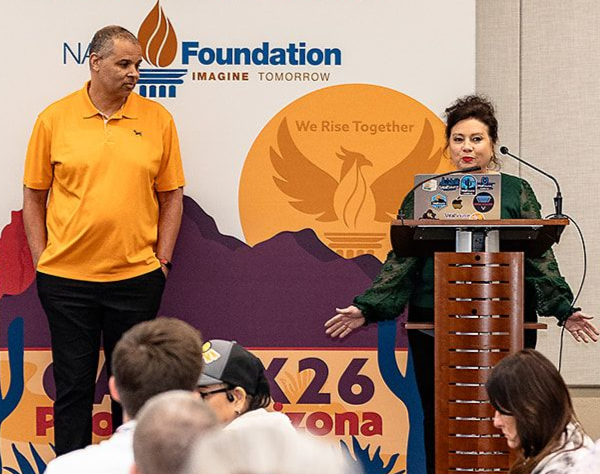
Store leadership was the focus of the education session “From Course Materials to Campus Strategy: What It Means to Be a Store Leader in 2026” at CAMEX in Phoenix, AZ.
The presenters focused on two aspects of leadership., Corsicana, TX, talked about how her style builds relationships across the campus, while Brian Wright, director, VolShop, University of Tennessee, Knoxville, stressed the importance of constantly improving the organization.
“Nobody was having any kind of fun, and that is not my personality,” Mitchell said. “I had to bring the place to life. I had to let them (the administration) understand the retail side of it and what we’re really all about.”
“There are a lot of connections that you make that have long-term benefits,” Wright added. “We’re always going to work on improving satisfaction for students while they are in the store. Retail is in the details, and we can do that with all the things we can offer our students.”
When Mitchell came to her store, she saw an institution that stayed in its own lanes. She made the effort to get to know people in every single department, then started working on projects to back it up.
One project was the Navarro Express at Christmastime. Using the film “Polar Express” as inspiration, the store places railroad tracks around the campus in an effort to connect everyone at the institution and in the community. The school president even plays the role of the conductor.
“We have been doing this for 11 years, and the entire community from four counties comes out for it,” Mitchell said. “We’re always asking our community for donations, so we do this for our community, and they give back in a very big way.”
The event even morphed into Beauville, a free community-wide family event with crafting, face painting, food trucks, live reindeer, and more. The event uses a space on campus set up like Whoville from Dr. Seuss’ “How the Grinch Stole Christmas” and is named after the school’s bulldog mascot, Beau.
She also spearheaded an event based on “Dancing with the Stars,” at the president’s suggestion, which has raised more than $100,000 for scholarships for students at the institution. One sponsor of the event, who also served as a judge, is a local businessman who went on to fund a million-dollar recreational vehicle technology program at Navarro College.
“Don’t think that didn’t resonate with our president, the board of trustees, and the faculty,” she said. “So, they love the bookstore, but more importantly, they value it and see the connection. They see we’re not only recruiting and retaining students; we’re recruiting community and recruiting investors, so your voice matters.”
That sort of proactive participation meant a lot to the president, who provided Mitchell with a seat at the table with the administration and board.
“They are letting me steer the ship with them as a partner,” she said. “We’ve opened eyes, we’ve opened ears, and we’ve opened hearts. We let them know we love what we do, that we love our school.”
Connecting with other segments of the university can certainly benefit the campus store. Once the baseline is set, the next step, according to VolShop director Wright is to work on taking the team to the next level.
The process for continuous improvement for Wright really took off when the VolShop completed its CAS standards project. The standards were developed by NACS and the Council for the Advancement of Standards to provide a framework that focuses on student success, operational excellence, and inclusion.
“It helps give the staff that 360-degree knowledge as we were all working together to get it through,” he said. “So, one of the things to start working on with your team is process literacy. A lot of times, we’re all working on processes in our organization but don’t know all the steps that we do.”
Using the CAS Standards to evaluate the store’s processes provided information on those that customers value. The added benefit is that when processes are improved, it makes a better experience for the shopper. The processes also become everyone’s responsibility.
An example is product replenishment. At the VolShop that process became automated and made it faster to get the right product to the customer at the right time.
“They should be constantly revisiting because we hold on to a lot of old processes,” Wright said. “We need to move forward to what the new processes are, and you can do that by monitoring the KPIs (key performance indicators) in your organization and seeing if you’re getting improvement.”
Another way to improve processes is to implement artificial intelligence.
“One area we’re moving into is with digital technology, digital books, courseware, and tech tools,” Wright explained. “That partnership is going to be more valuable than ever. We’ve been working with it for a long time, but expanding and growing those partnerships can be really beneficial as we go forward, especially as AI becomes more prevalent on your campus.”
Store leadership is also required to prepare for the future. Managers should be overseeing staff development as well as looking for chances to advance themselves.
“A lot of times, people become our bosses who don’t understand our work, so we need to take the opportunity to start looking at becoming heads of our auxiliary departments,” Wright said. “That way, we can help protect the store and support the store in the future, because too few of us move forward.”
Bulldog Bookstore’s Mitchell added one last thought on moving the store forward. “It’s very, very important to stay relevant and have your staff trained,” she said. “You don’t want to just walk away and say, ‘I’m retiring. I’m done.’ Think about the future of the people behind you, so I’ve really tried to develop a succession plan. It’s important to the success of your store and to keep the lease operators away.”